CURRICULUM VITAE
LIST OF PUBLICATIONS IN REFEREED JOURNALS

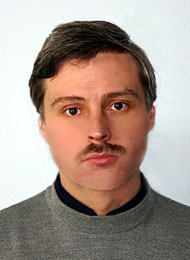
ANDREI ANATOLIEVICH ZVYAGIN

Citizenship: Ukraine

Address : B.I. Verkin Institute for Low Temperature Physics and

Engineering of the National Ukrainian Academy of Sciences, 47, Lenin Avenue,

61103, Kharkov, Ukraine

Phone : (+38) 057-341-09-85 

E-mail address : zvyagin@ilt.kharkov.ua

Born : November 23, 1959, Kharkov, the USSR (Ukraine)

Nationality : Ukrainian

Marital status : Married (no children)

Languages : Russian (native), English, Ukrainian, German, elements of French, Italian and Swedish.

ACADEMIC DEGREES AND TITLES

Full Professor (Theoretical Physics), from the Ministry of Education and Science of Ukraine, Kiev, 2005.

Senior Research Fellow (Theoretical Physics), equivalent to Associate Professor, from the Ukrainian Academy of Sciences, Kiev, 1993.

Doctor of Sciences in Physics and Mathematics (emphasis on the Theoretical Physics) from the B.I. Verkin Institute for Low Temperature Physics and Engineering of the Ukrainian Academy of Sciences, Kharkov, 1993. Thesis: Quantum Effects in Interacting Spin and Strongly Correlated Electron Low-Dimensional Systems

Candidate of Science in Physics and Mathematics (emphasis on the Physics of Magnetism), equivalent to Ph.D., from the Institute for Low Temperature Physics and Engineering, of the Academy of Sciences of the Ukrainian SSR, Kharkov, 1985. Advisor Prof. V.M. Tsukernik. Thesis: Role of Anisotropic Interactions in Static and Kinetic Properties of Magnets.

Diploma in Physics (emphasis on the Theoretical Physics) from the Kharkov State University, 1981.

POSITIONS

Leading Researcher , Staff Position, B.I. Verkin Institute for Low Temperature Physics and Engineering, of the National Academy of Sciences of Ukraine, Kharkov, 1995 - to the present time.

Senior Researcher , Staff Position, the same Institute, 1989-1995.

Researcher , Staff position, the same Institute, 1986--1989.

Junior Researcher , the same Institute, 1986--1986.

Engineer , the same Institute, 1981--1986.

Graduate and undergraduate student , Kharkov State University, Department of Physics, 1976-1981.

PH.D. THESES SUPERVISED

Ya.Yu. Segal, Thesis: Quantum Features of Static and Kinetic Properties of Low-Dimensional and Low-Symmetric Magnets, Kharkov, 1993.

T.V. Bandos , Thesis: Thermal and Electro-Magnetic Field Effect on Current and Critical States of Superconductors and Normal Metals, Kharkov, 1995.

A.V. Makarova , Thesis: Features of Magnetic Phase Transitions in Low Dimensional and Correlated Electron Systems, Kharkov, 2005.

OTHER PROFESSIONAL ACTIVITIES

Member of the Advisory Board (2005-2008), Member of the Editorial board (since 2009) of the journal Fizika Nizkih Temperatur (American Institute of Physics translation: Low Temperature Physics); the scientific editor of the journal 1992--2000.

Member of Scientific Councils at the Institute for Low Temperature Physics and Engineering (Physics of Magnetism) 1995-2002, and of the Institute for Single Crystals (Theoretical Physics) 1994-1999.

Member of Scientific Councils at the Institute for Low Temperature Physics and Engineering: New Problems of Mathematics, Theoretical Physics of the Condensed Matter, Low Temperature Magnetism and Optics of Ferroics;

Referee for the journals: Physical Review Letters, Physical Review A,B,E, European Physical Journal B, Journal of Physics: A, Journal of Physics: Condensed Matter, JETP, Modern Physics Letters A,B, Low Temperature Physics.

PARTICIPATION AT SOME CONFERENCES, WORKSHOPS, INVITED TALKS

Abdus Salam International Centre for Theoretical Physics, Trieste, Italy:

1993, Research Workshop on Condensed Matter Physics,

1994, College on Quantum Phases,

1995, Research Workshop on Condensed Matter Physics,

1996, Miniworkshop on Strong Electron Correlations,

1997, Research Conference and Workshop on Superconductivity, Andreev reflections, and proximity effects in mesoscopic superconductors;

1998, Conference on the Statistical Field Theory.

Laboratoire de Physique des Solides, Universite Paris XI (Paris-Sud), Orsay, France, 1995;

High Magnetic Field Laboratory, Max Planck Institute for Solid State Physics and CNRS, Grenoble, France, 1995.

Institute of Theoretical Physics, Goteborg University and Chalmers University of Technology, Goteborg, Sweden, 1995, 1996, 2002;

Institute for Theoretical Physics, Hanover University, Hanover, Germany, 1996, 2005.

Research Conference on Correlated Electron Systems, NORDITa, Copenhagen, Denmark, 1996.

Department of Physics, Florida State University, Tallahassee, Florida, USA, 1997.

Institute for Theoretical Physics, Cologne University, Cologne, Germany, 1997, 1998.

Nordic Institute for Theoretical Physics, Copenhagen, Denmark, 1997.

Theoretical Physics II, Augsburg University, Augsburg, Germany, 1998.

International Conference on Strongly Correlated Electron Systems, Paris, France, 1998.

XX International Conference on Statistical Physics, Paris, France, 1998.

NATO Advanced Study Institute Modern Trends in Magnetostriction Studies and Applications, Kiev, Ukraine, 2000.

Max Planck Institute for Physics of Complex Systems, Dresden, Germany, 1999, 2000, 2001, 2003.

International Conference on Magnetic Correlations, Metal-Insulator Transitions and Superconductivity in Novel Materials, Dresden, Germany, 2001.

Max Planck Institute for Chemical Physics of Solids, Dresden, Germany, 2001, 2002.

International Conference on Strongly Correlated Electron Systems, Krakow, Poland, 2002. International Conference on Theoretical Physics, Paris, France, 2002.

International Conference on Nonlinear Dynamics, Kharkov, Ukraine, 2004.

International Bogolyubov Conference New Trends in Mathematics and Theoretical Physics, Kiev, Ukraine, 2004.

European Science Foundation Workshop Highly Frustrated Magnetism, La Londe Les Maures, France, 2005.

High Magnetic Field Laboratory, Forschungzenter Rossendorf-Dresden, Germany, 2005, 2007.

Leibniz Institut für Festkörper- und Werkstoffforschung, Dresden, Germany, 2006.

RESEARCH INTERESTS

Magnetism theory : phase transitions, low-dimensional magnetic models and systems, resonance excitations of spin systems, incommensurate magnetic structures (Dzyaloshinsky-Moriya interaction, spin frustrations, next-nearest-neighbor and further couplings), gapped states in 1D spin systems (RVB-like, spin-Peierls, integer-spin Heisenberg systems, spin ladders), electron spin resonance in low-dimensional magnets, multisublattice spin systems (magnetization plateaux), chiral magnets, co-operative Jahn-Teller effect and other interactions of orbitals with spin degrees of freedom, magnetic impurities, disordered spin systems;

Low dimensional many-body theories : nonlinear dynamics, exactly solvable quantum models (1D and 2D quantum spin models, 2D statistical models, 1D strongly correlated electron systems (Hubbard model, t-J model, Luttinger liquid, etc.)), conformal field theory, (1+1) quantum field theories;

Strongly correlated electron systems : magnetic and hybridization impurities, Kondo effect, Kondo and Anderson lattices, heavy fermions, disordered correlated electron systems, non-Fermi-liquid behavior, “unconventional” superconductivity, co-existence of magnetic and superconducting fluctuations, strong correlations between spin, charge and orbital degrees of freedom in correlated electron systems, interactions between electrons and a crystal lattice (phonons);

Mesoscopic and nanoscale effects in condensed matter physics : the Aharonov-Bohm-Casher topological effects, persistent currents, conductance, Coulomb blockade oscillations, interference of these effects, Kondo effects in quantum dots and wires;

Quantum computers : qubits, gates, condensed matter realizations;

Superfluid  3He : magnetic excitations.

MAIN RESULTS

Quantum spin systems :

In the series of papers multichain (effectively two-dimensional) quantum spin models with the breaking of the time-reversal and parity symmetries (TP symmetry is preserved) were proposed and solved exactly by using the quantum inverse scattering method. Later these results were reproduced by several other groups. We predicted the absence of a gap for elementary excitations. We conjectured that chiral spin terms (the effect of the latters is similar to the Chern-Simons topological fields in the fractional quantum Hall systems) were the reason for the vanishing of a spin gap in these zigzag-like systems. This result was confirmed later by non-Abelian bosonisation and density matrix renormalization group calculations. We showed that the gap for elementary excitations, absent for lattice chiral systems, revealed itself for the systems with linearized about Fermi points dispersion laws of elementary excitations, similar to chiral quantum field theories. New magnetic and spin chiral incommensurate phases and phase transitions were predicted for quantum spin systems with spin frustration. We reviewed studies of this class of exactly solvable multichain quantum systems (see the review article II.). We studied features of the temperature behavior of thermodynamic characteristics of a quantum spin chain near the quantum phase transition caused by spin-frustrating next-nearest-neighbor interactions and so-called ring interactions. Dynamical characteristics, like the dynamic structure factor, inhomogeneous susceptibility, static structure factor, etc., important for neutron scattering experiments are calculated for quantum spin chains with the spin frustration and multi-spin interactions. We explained many features of the low-temperature thermodynamic characteristics of a quasi-1D frustrated magnet Li2ZrCuO4. We calculated the ordering temperature for weakly coupled quantum spin chains with spin-frustrating nearest and next-nearest-neighbor interactions. We provided the theoretical explanation for experimentally observed thermodynamic and dynamic (Raman scattering) characteristics of a spin chain compound α-TeVO4. Thermodynamics and elementary excitations of a spin-1/2 chain with alternating nearest neighbor interactions and next-nearest neighbor ones are studied.

We exactly studied the behavior of an impurity in a Heisenberg antiferromagnetic quantum spin chain. Using the Bethe's ansatz we calculated the low temperature behavior of the magnetic susceptibility and specific heat of an open Heisenberg spin-1/2 chain, existing, e.g., due to nonmagnetic impurities. We pointed out features of possible additional fixed points in the renormalization group analysis of the two-parametric impurity and the necessity of the renormalization of the spinon's velocity in the bosonization study of finite-length quantum spin chains (or, systems with non-magnetic impurities). The behavior of an impurity in an alternating quantum spin chain with the spin-gap was exactly investigated.

We proposed several models of quantum spin chains with embedded magnetic impurities with disordered random distributions of the impurity-host couplings, which possess exact integrability. We calculated measurable characteristics of such systems: the temperature and external magnetic field dependencies of the specific heat, magnetic susceptibility, correlation functions, etc. We showed that depending on the “degree of disorder” the behavior of systems was changed drastically from quenching of impurities to the remnant magnetization of them. Some universal low-temperature field- and frequency- dependencies of these models, like correlation length, dynamical magnetic susceptibility, Knight’s shift, resonance line width, etc. were calculated analytically.

We proposed how the disorder in the distribution of characteristics of magnetic impurities in quantum spin chains and non-Fermi-liquid systems can cause the magnetic ordering in the system. We explained how such a disorder can reduce the Neel temperature for other quasi-one-dimensional antiferromagnets, explaining recent experiments. We proposed a theory for thermal currents in spin-1/2 antiferromagnetic chains with disordered ensembles of magnetic impurities.

In a number of papers theoretical studies of static properties of quantum spin chains were performed. The Jordan-Wigner transformation was generalized for multisublattice spin chains. We predicted that a gapless spin mode exists for such systems with the odd number of sublattices, and does not for even ones. Later these our results were reproduced by other authors. Magnetizations of sublattices for a bi-axial alternating quantum spin system in an external magnetic field were calculated. The effective theory for a quantum spin-1 chain was proposed. We developed a theory, which explained the onset of the Neel antiferromagnetic ordering in a spin-Peierls system, explaining experiments on organic low-dimensional electron systems.

Theories for the co-operative Jahn-Teller-like effect and other magneto-elastic effects for antiferromagnetic spin-1/2 chains were constructed and developed. In particular, we predicted a spontaneous onset of the magnetic anisotropy, or the alternation of effective g-factors due to shifts of ligands, surrounding magnetic ions in effectively one-dimensional spin systems. We explained how low-energy excitations in quasi-one-dimensional spin-1 compound DTN change the character of their collective behavior from bosonic to fermionic near magnetic field-governed quantum critical points. We used our above mentioned theory to explain features of magnetic and ultrasound studies in DTN. We constructed a theory, which explains the features of the temperature and magnetic field behavior of sound velocity and sound attenuation in a antiferromagnet terbium ferroborate.

In several papers one-dimensional quantum spin antiferromagnetic systems with the Dzyaloshinsky-Moriya coupling were studied exactly, and a number of their properties (absent for three-dimensional magnetic systems with such an interaction) were predicted. Later many groups of authors reproduced these results and they were confirmed experimentally.

The series of our papers is devoted to the theory of essentially nonlinear effect of the parametric resonance in quantum spin systems. In particular, for three-dimensional magnets the effects of non-resonance terms under the conditions of the resonance pumping were studied. Effects of various relaxation mechanisms for spin systems under parametric excitation were investigated. Dynamical changes of the equilibrium spin configuration in the parametric resonance were predicted. The change of the threshold for a parametric instability of magnons pumped by inhomogeneous plane waves was calculated. The absence of a parametric instability for fermionic modes of superfluid He-3, excited by a microwave magnetic field, was predicted. In a number of papers parametric resonances were studied for quantum spin chains with various spin-spin interactions. We exactly proved that for these quantum spin chains the parametric instability was absent and there was no threshold effect in the magnitude of an ac magnetic field for such a parametric pumping. The theory of the parametric resonance for a quantum spin chain under the effect of a sound wave pumping was exactly constructed. We also developed the theory of electron paramagnetic resonance in quantum spin chains with the magnetic field-induced spin gap. We predicted the special behavior of the shift of the ESR position and the linewidth in spin chains with next-nearest neighbor interactions and alternation.

We proposed a theory, which explains many features of a recent experiment on parametric pumping of magnons, where it was claimed that the high-temperature Bose-Einstein condensation of magnons was observed.

Strongly correlated electron systems:

We proposed several models of quantum interacting electrons with embedded magnetic impurities and metals with Kondo impurities with disordered random distributions of the impurity-host couplings, which possess exact integrability by means of the Bethe's Ansatz. We calculated with the high accuracy observable characteristics of such systems: the temperature- and external magnetic field- dependencies of the specific heat, magnetic susceptibility, correlation functions, etc. We showed that depending on the “degree of disorder” the behavior of systems was changed drastically from quenching of magnetic impurities by spins of the host for a weak disorder, to the remnant magnetization of impurities for a strong disorder. Good qualitative agreement with recent experimental data on non-Fermi-liquid behaviors of some rare earth and actinide alloys was achieved. Some universal low-temperature magnetic field and low frequency dependencies of this model, e.g., correlation length, dynamical magnetic susceptibility, Knight’s shift, resonance line width, etc. were calculated analytically. We derived from the first principles the distribution of Kondo temperatures, used to explain recent experiments, and found how such a distribution depends on the effective dimensionality of the system.

We proposed nontrivial examples of correlated electron systems with “unconventional” superconducting properties and provided exact theories for them. For instance, we constructed the model of a superconducting system with spin-triplet pairs and calculated its behavior in external magnetic and crystalline fields. We exactly calculated the behavior of a single magnetic/hybridization impurity and a finite concentration of them in correlated electron hosts with the spin gap. It was shown that for these systems the quantum phase transition takes place, governed by the concentration of magnetic impurities; we predicted the co-existence of superconducting and magnetic fluctuations in these systems, a phase transition to the phase with spontaneous ferrimagnetic ordering. We explained that a hybridization between impurities and the host and anisotropy of the hybridization between localized  5f-electrons and itinerant ones (channel anisotropy) yield a non-Fermi-liquid behavior in a high-energy phase (or for a system with dilute 5f-centers) and the formation of superconducting fluctuations for a dense case (finite concentration of 5f-orbitals) for some U compounds. We showed that single magnetic impurities in a correlated electron host with the spin-triplet pairing manifested multi-channel Kondo behavior, while for a finite concentration of impurities the behavior of superconducting correlations were dependent on the values of spins of impurities and on the difference between energy levels of the localized impurities' configurations. We proposed a model of itinerant electrons, hybridized with 4f ones, with the low-energy non-magnetic (non-Kramers) doublet, that reveals heavy electron mass and formation of superconducting and antiferroquadrupolar fluctuations.

We constructed and exactly solved several one-dimensional models of strongly correlated electrons with magnetic impurities for exchange (Kondo-type), and hybridization (Anderson-type) interactions between an impurity and a host using the quantum inverse scattering method. Perturbative methods cannot be applied in those cases. We showed that due to the hybridization of a magnetic impurity with itinerant electrons both charge and spin degrees of freedom of the impurity were affected by the host interaction. Magnetic susceptibility and specific heat features for the impurity were calculated exactly. We rigorously proved that there was no essential difference between the Kondo behaviors of magnetic impurities in periodic and open chains, and clarified the question about the role of forward and backward scattering in the Kondo effect. We explained the hidden character of the Kondo effect for a ferro- and antiferromagnetic impurity due to electron correlations in the host. We showed that the integrable magnetic impurity in correlated electron hosts revealed a mixed valence and studied manifestations of that effect on the characteristics of the impurity. We explained how the Ising-like (i.e. the “easy-axis”) magnetic anisotropy affects the behavior of a magnetic impurity.
We exactly proved that for all exactly solved by Bethe ansatz models of correlated electrons there is no spin-charge separation: One of two low-energy states, which have Fermi seas for all those models, necessarily carries spin and charge. This study reveals frames of the applicability of the Luttinger liquid approach (in which spin-charge separation exists) for the description of interacting electron low-dimensional systems.

We pointed out the importance of two Fermi points (instead of usual in the Bethe ansatz studies one Fermi point) for spin excitations in the Kondo problem. We solved exactly by the Bethe ansatz method the Kondo problem with open boundary conditions.

We proposed the first nontrivial exactly soluble models for a one-dimensional Kondo lattice (or a mixed-valent lattice) system (i.e. correlated electron system with the finite concentration of magnetic impurities). We showed that such a finite concentration of impurities led to new (additional) magnetic phase transitions, caused by a (narrow) band appeared due to the thermodynamic number of magnetic impurities.

We proposed an explanation for the magnetic low temperature behavior of the specific heat, magnetic susceptibility and resistivity of quasi one-dimensional heavy fermion system Yb4As3. The novel realization of the Jahn-Teller like effect in magnetic low-dimensional correlated electron systems is proposed and studied. We also proposed the explanation of the origin of an effective heavy mass of carriers in the first heavy electron 3d oxide LiV2O4 using the spin and lattice frustration.

We exactly calculated the photoemission resonant spectra for the degenerate Anderson model in the framework of the Bethe ansatz. It was shown that exact Bethe ansatz results differ from the well-known approximate ones (obtained using a variational approach, a non-crossing approximation, or a slave-boson technique) in several eV.

The new class of models of spin and electron systems with the “gauge” interchain coupling was introduced and solved exactly. It was shown, e.g., that such a “gauge” (phase) interaction produced effects similar to the ones in the fractional quantum Hall effect systems, like fractional statistics of elementary excitations and appearance of the incommensurate structures. We also proposed the exactly integrable correlated electron model with nearest and next-nearest-neighbor interactions. The latter produces new incommensurate phases with spontaneous ferrimagnetic and charge ordering.

The exact theory describing a highly correlated multichain electron system (supersymmetric t-J model) with zigzag-like interactions was developed.

We exactly solved the generalized Anderson model with the Hubbard-like repulsion and Hund's rule exchange interaction of localized electrons from different orbitals and with different spin projections. We showed that for some values of the repulsion and exchange constants the system reveals a transition from a non-Fermi-liquid to the Fermi liquid behavior. This theory can be applied also to the case of two Kondo impurities, or two quantum dots in a system.

We proposed the theory of the Jahn-Teller-like spontaneous onset of the anisotropy in low-dimensional strongly correlated electron system due to an interaction with ligands of magnetic ions.

The theory for the effective mass enhancement for heavy fermion systems (examined experimentally in de Haas-van Alfen experiments) was developed by use of a two-band electron model. This theory explained several characteristic features of experiments on the measurements of the specific heat and de Haas-van Alfen oscillations in heavy fermion systems.

We explained an anomalous temperature behavior of the electron paramagnetic resonance in quasi-one-dimensional system   α’-NaV2O5, where charge ordering and spin-Peierls-like doubling of elementary magnetic cell took place for a trellis-like lattice of intermediate-valent V ions.

We proposed a theory of the electron spin resonance for non-Fermi-liquid systems (for a metal with a multichannel Kondo impurity). We also proposed a qualitative explanation of the recent ESR experiment on YbRh2Si2.

Mesoscopic/nanoscale effects in correlated electron and spin systems;

Quantum computers

 In the series of papers exact many-body quantum theories for persistent currents in one-dimensional strongly correlated electron systems were developed. For the first time we showed that the persistent current vanished for a half-filled repulsive Hubbard ring. It indicates the phase transition to an insulating phase. The Aharonov-Bohm effect in a multi-channel Hubbard ring (with the channel degeneracy) was studied exactly. We exactly examined theoretically the features of the Aharonov-Casher effect for a repulsive Hubbard chain and antiferromagnetic spin-1/2 ring. The exact quantum mechanical theory for the Aharonov-Bohm-Casher effects in a 1D model of a type-II superconductor (the attractive Hubbard model with the spin gap) was developed (any perturbation theory or bosonization scheme cannot be applied in this situation). Temperature dependences of those persistent currents were found for one-dimensional correlated electron systems. The results of most of these works were later reproduced independently by other authors. We reviewed the investigations of persistent currents in strongly correlated mesoscopic electron quantum rings (see the review article I.).

Using the exact Bethe ansatz method theories of quantum collective topological effects for metallic rings of free electrons with magnetic or hybridization impurities (Kondo-like, or of Anderson-type) or quantum dot connected to a ring were developed. The changes in magnitudes and periods of oscillations of mesoscopic persistent current were predicted. Such changes are connected with the effective electron-electron couplings appeared due to the interaction between host electrons and the impurity/quantum dot. We showed that the Coulomb blockade-like effects changed phases (the parity) of persistent currents for highly correlated electron systems and metallic rings with the Anderson impurity (they model quantum rings with a quantum dot). We calculated several characteristics (like the magnetic moment and persistent currents) for a correlated electron ring, and of such a ring of a finite length with embedded quantum dot. These our results were later re-obtained by several other groups.

The exact theory for the nonlinear effect of point-contact boundary potentials on Coulomb blockade-like oscillations was performed by applying the Bethe ansatz method for one-dimensional strongly correlated electron systems (cases for spinless fermions and electrons with spin). We proposed the possibility to measure the electron-electron coupling value directly by using the predicted value of the above mentioned nonlinear oscillating response. The interference of such Coulomb blockade-like effects and persistent current oscillations in external electro-magnetic fluxes for several models of one-dimensional highly correlated electrons and metallic rings containing magnetic impurities was predicted.

We exactly proved that forward scattering impurities do not change correlation function's behavior for the one-dimensional highly correlated electron systems. The result was generalized for multichain and alternating spin interacting systems.

Microscopic oscillations (with the fractional periods) of persistent currents in quantum rings were predicted exactly for systems of strongly correlated electrons with spin-gapped ground states (like the Hubbard chain with attraction of electrons), and metallic systems with magnetic and hybridization impurities/quantum dots.

Finite-size (mesoscopic) corrections were calculated for the multichannel ring with the Kondo impurity (under-, over-, and totally screened cases); the results were generalized for nonzero crystalline electric and external magnetic fields. By using these finite-size corrections several physical characteristics of those systems were calculated exactly (like persistent currents, magneto-resistivity, specific heat, etc.).

By applying the Bethe's ansatz the exact theory of mesoscopic spin persistent currents in an antiferromagnetic spin-1/2 chain with the finite concentration of spin-S impurities (one-dimensional ferrimagnet) was constructed. We showed that impurities changed the ground state structure of the system yielding additional periods of oscillations of these spin persistent currents.

Characteristic features of the influence of the Aharonov-Casher effect to the de Haas-van Alfen type of electron oscillations were predicted for conducting low-dimensional electron systems.

We proposed the new scheme of manipulation with qubits in quantum computers, based on recent experiments on Josephson junction-based qubits.

We proposed an explanation for recently observed in-gap low-energy states for Bose particles on a 1D lattice: We studied a Bose-Hubbard-like one-dimensional model with open boundary conditions and with a local boundary potential applied, which gives rise to the boundary bound state, existing in the gap for the insulating phase of the Bose-Hubbard chain.

THE BOOK

A.A. Zvyagin, Finite Size Effects in Correlated Electron Models: Exact Results

(Imperial College Press, London, & World Scientific, Singapore, 2005).

Many of our above mentioned original results, together with the results of other authors, were reviewed in our book. The book presents to the reader main methods of the modern condensed matter theory for low-dimensional correlated electron systems: the Bethe's ansatz (BA), with main its modifications: co-ordinate BA, nested BA, thermodynamic BA, algebraic BA (or the quantum inverse scattering method), thermal BA (or the quantum transfer matrix approach); scaling; conformal field theory; Abelian and non-Abelian bosonization, etc.

LIST OF PUBLICATIONS IN REFEREED JOURNALS