Acting Head of the Department is Doctor of Science Yu.G. Naidyuk
tel.: +(380)-57-340-22-11
fax: +(380)-57-340-33-70
e-mail: naidyuk@ilt.kharkov.ua
The department creation was initiated by academician B.I.Verkin in 1970 for investigation of the different physical phenomena arising in the structures with weak electrical links, which encompassed the tunnel junctions and point contacts with metallic conductivity.
Since then and until 2011 the department was headed by Prof. Igor K. Yanson, who pioneered the observation of electromagnetic radiation from superconducting tunnel junctions (1964) that presented a direct confirmation of the nonstationary Josephson effect. His another important achievement - discovery of the point-contact spectroscopy (1974), which has brought into being a new approach for investigation of the conduction electrons interaction with different types of quasiparticles excitations in metallic systems.
I.K.Yanson is awarded by the Ukrainian state prize (1980), Hewlett-Packard prize of European physical society (1987) and Alexander von Humbold Award (1996).
The department staff consists of 21 collaborators including 16 scientific fellows, among them are 5 Doctors (Ph. D. Habil.): Akimenko A. I, Balkashin O. P., Khotkevich A. V., Naidyuk Yu. G., Shklyarevskii O. I. and 6 Candidates (Ph. D.) of sciences: Beloborod`ko S. I., Bobrov N. L., Chubov P. N., Fisun V. V., Kamarchuk G. V., Kvitnitskaya O. E.
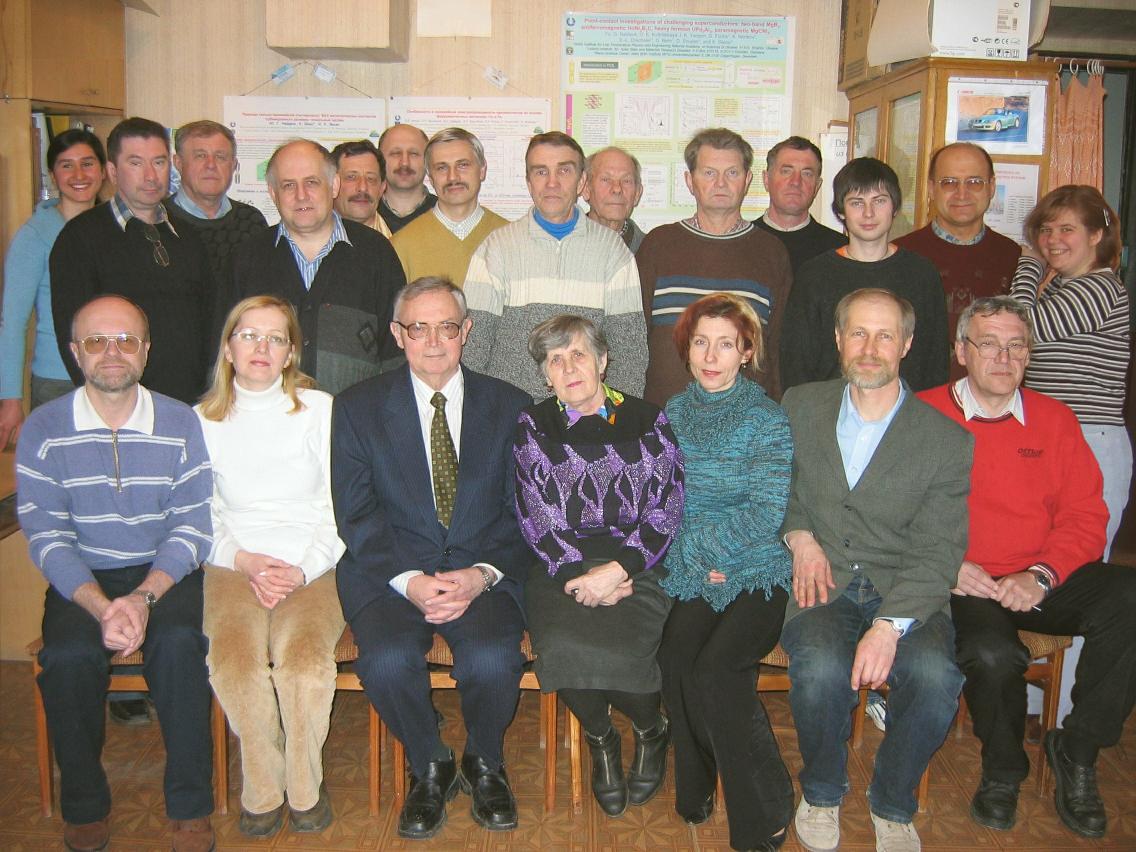
At the present the department carries out the investigations applying of the point-contact spectroscopy method in the following directions:
- Kinetics of the relaxation processes and nonstationary phenomena in the solid conductors under high-frequency irradiation.
- Kondo effect in ultrasmall metallic contacts.
- Two-level systems in metallic glasses.
- Electron-phonon and electron-magnon interactions in a variety of materials - metals, semiconductors, organic conductors, heavy- fermion compounds, high-temperature superconductors, etc.
- Coexistence of magnetism and superconductivity.
- Electron density of states, gap parameter symmetry and anisotropy in high-temperature and heavy-fermion superconductors.
- Andreev-reflection processes in different types of superconducting S-c-N contacts with simple metals, borocarbides, borides, high-Tc metalloxides and heavy-fermion systems.
- Unusual magnetic and superconducting ground states of heavy-fermion systems and mixed valence compounds.
- Conductance quantization in nanobridges.
- Observation of shell structure in alkali metal nanowires.
- Study of nonlinear effects in ferromagnetic contacts (spin transfer torque).
Published books, reviews and top articles:
Naidyuk Yu. G., Yanson I. K. Point-contact spectroscopy, Springer, New-York, 2004, -297p.The most significant results, which have been got at the department:
Khotkevich A. V., Yanson I. K. Atlas of point-contact spectra of the electron-phonon interaction in metals. Kluver, 1995, -168p.
Yanson I. K. Point-contact spectroscopy of EPI in pure metals. Sov. J. Low Temp.1983, V.9, N7.
Yanson I. K., Shklyarevskii O. I. Point-contact spectroscopy of metallic alloys and compounds. Sov. J. Low Temp. 1986, V.12, N9.
Yanson I. K. Point-contact spectroscopy of high-Tc superconductors. Sov. J. Low Temp. 1991, V.17, N3.
Naidyuk Yu. G., Yanson I. K. Point-contact spectroscopy of heavy-fermion systems. J. Phys.C: Cond. Matter, 1998, V.10, P.8905-8938.
J. M. Krans, J.M.van Ruitenbeek, V.V.Fisun, I.K.Yanson, and L.J.de Jongh. The signature of conductance quantization in metallic point contacts. Nature, v.375, pp.767-769 (1995).
A.I. Yanson, I.K. Yanson and J.M. van Ruitenbeek, Observation of shell structure in sodium nanowires. Nature v.400, 8 July 1999, pp.144-146 .
The department possesses the set of high sensitive point-contact spectrometers well equipped by very stable cryogenic devices allowing measurements in wide temperature (0.8-300 K) and magnetic field (0-9T) range as well as measurement under high frequency irradiation (from sound up to laser).- Discovery and exploitation of the point-contact spectroscopy method.
- Kinetics of nonequilibrium phonons with Debye energies has been studied and their lifetimes detected in a variety of metals.
- Observation of the size-dependent Kondo scattering in the point contacts with magnetic impurities.
- Effect of the conductance quantization in atom-sized metallic contacts.
- Creation of a summary atlas of the electron-phonon interaction functions for 31 metals studied at the department.
- Enhancement of a two-level system influence on point-contact spectra of the electron-phonon interaction in ultrasmall contacts.
- Sign reverse of the point-contact spectra in semimetals due to the strong localization.
- Discovery of a switching effect in metaloxide superconductors.
- Establishing of the new superconducting (SC) state near antiferromagnetic ordering temperature in borocarbide superconductors.
- Formation of SQUID between heavy-fermion URu2Si2 and ordinary superconductor to determine SC order parameter (OP) symmetry.
- Revealing of the strong pair-breaking effect of the normal metal--heavy-fermion superconductor interface.
- Determining of the temperature and magnetic field dependence of SC OP in simple superconductors Zn, In, Sn, Nb by Andreev reflection study.
- Observation of two-gap SC state and specific electron-phonon interaction in MgB2.
- Texas A&M University, College Station, USA.
- Chalmers University of Technology, Geteborg, Sweden.
- Royal Institute of Technology, Stockholm, Sweden.
- IFW Dresden, Germany.
- Universitaet Karlsruhe, Karlsruhe, Germany.
- Institut des Materiaux Jean Rouxel, Nantes, France.
- High Magnetic Field Laboratory, Grenoble, France.
- Kamerlingh Onnes Laboratory, Leiden, The Netherlands.
- Katolieke Universiteit Nijmegen, The Nethelands.
- Institute of Experimental Physics, Kosice, Slovak Rep.
Updated on March 21, 2005