|
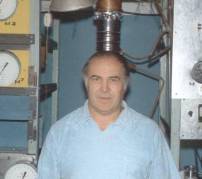
|
Head of Department:
Doctor of Physics & Mathematics
Vyacheslav Aleksandrovich Konstantinov
Doctor of Physics and Mathematics, leading researcher
at Department for
thermal properties of molecular crystals
at ILTPE NAS Ukraine
61103,
Kharkov-103, Prospect Lenina, 47
e-mail:
konstantinov@ilt.kharkov.ua
Tel.: +38-(057)-340-10-27
Fax :+38-(057)-340-33-70 |
Was born on October 28, 1948. He graduated from Kharkov State
University (Department of Physics of Crystals) in 1971. In ILTPE he works since
1973; since 1979 he has been working in department of thermal properties of
molecular crystals. He defended his PhD thesis entitled "The isochoric thermal
conductivity of solidified gases" in 1998, and a doctorate thesis, "Heat
transfer in simple molecular crystals and their solutions at temperatures of the
order and above the Debye temperature" in 2003.
The main direction of scientific activity is the study of heat
transfer processes in simple molecular crystals and their solutions.
Main results:
A gradual transition was investigated in molecular crystals
and their solutions from the pure phonon mechanism of heat transfer to the
heat transfer by "diffusive" modes with increasing temperature and
concentration of impurities. It was shown that the Bridgeman coefficient,
which characterizes the dependence of the thermal conductivity from the
molar volume, is determined by the competition of heat transfer by phonons
and "diffusive" modes.
The correlation between the character of molecular rotation
and thermal conductivity behavior has been studied. It is found that with
the increase in the molecular reorientation frequency at growing temperature
the isochoric thermal conductivity becomes higher too. It is shown that this
effect occurs because the phonon scattering at collective rotational
excitations decreases sharply as the rotational correlations of the
neighboring molecules grow weak.
V.A. Konstantinov is the author of about 70 articles in
scientific journals and two reviews:
-
Konstantinov V.A., Manzhelii V.G., “Phonon scattering and
heat transfer in simple molecular crystals”, Lectures from the Winter
School of Theor. Phys., 1993 Wroclaw, Poland, Plenum Press New York and
London, 1994
-
Konstantinov V.A., Heat Transfer in Molecular Crystals,
In Book: Heat Transfer - Theoretical Analysis, Experimental Investigations
and Industrial Systems, Aziz Belmiloudi (Ed.), “InTech" Open Access
Publisher, p.157-188 (2011)
Selected publications:
-
Konstantinov V.A.
Heat transfer by low-frequency phonons and "diffusive" modes in molecular crystals
// Low temperature physics. - 2003. - Vol. 29. - P. 422 - 428.
-
Konstantinov V.A., Manzhelii V.G., Pohl R.O.,Revyakin V.P.
Search for the minimum thermal conductivity in mixed cryocrystals
(CH)1-xKrx
// Low temperature physics. - 2001. - Vol. 27.- № 9 - P. 858 - 865.
-
V.A. Konstantinov, E.S. Orel, V.P. Revyakin. Molar
volume dependence of the thermal conductivity in mixed cryocrystals.
// Low temperature physics. - 2003. - Vol. 28. - № 2 - P. 136 - 139.
-
В.А. Константинов, V.V. Sagan, A.V. Karachevtseva, V. P.
Revyakin, O.I. Pursky, Heat transfer in the plastic phases I and II of
cyclopentane, CEJP.-2014.-V.12(9).-P.654-659
-
V.A. Konstantinov, A.I. Krivchikov, O.A. Korolyuk V.P.
Revyakin, V.V. Sagan, G.A. Vdovichenko, A.V. Zvonaryova, Heat transfer in
different phases of solid cyclohexene, Physica B. – 2013, - V.424, P. 54–59
|